Showing posts with label Tips. Show all posts

Printer ink costs is major contributor for every business entity. We have moved to digitization to improve efficiency and avoid printing. Still some documents has to be printed and shared in hard copy form. Besides printer ink costs, splashing too much ink is harmful to environment.

save-printer-ink-1
Matt Robinson [via] did an interesting comparison of different typefaces or fonts to check which font takes least amount of ink and which font was ink guzzlers.

Two of them offer reserved parking spaces for drivers of eco-friendly cars
By Irene Tham

(Ecologikal Notes: which mall in Malaysia will take the lead?)

GOING green has its privileges for drivers of eco-friendly wheels, such as hybrid cars, who get to use reserved parking spaces at some malls.

At least two malls here - 313@Somerset in Orchard Road and City Square Mall in Kitchener Road - have such reserved spots, even if these tend to be mostly empty. The two malls' spokesmen said they want to give drivers of eco-friendly cars a pat on the back.

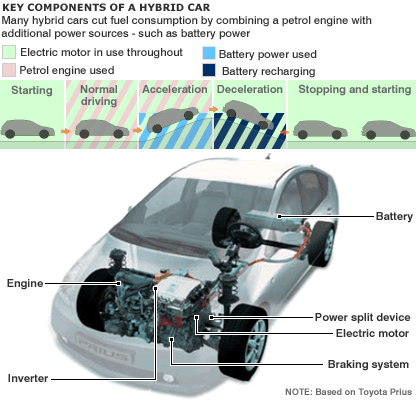
Hybrid cars are so called because they have a petrol engine as well as an electric one. They pollute less but cost more than petrol-driven cars.

There are only 2,600 hybrid cars (the Toyota Prius, Honda Civic Hybrid and Lexus RX400h models) here, compared to 571,600 petrol-driven cars.

All-electric cars are also privileged at the two malls but there is only one such vehicle here as of last year, the Land Transport Authority's website showed.

A spokesman for property developer City Developments Ltd (CDL), which manages City Square Mall, said: 'We encourage shoppers to choose eco- friendly vehicles to save the environment.'

Article Source

Sustainability initiatives in project offices at 313@somerset

The project teams at 313@somerset are committed to delivering a sustainable future for all our stakeholders and we recognise the importance of being accountable for what we take, what we create and what we leave behind.

Our project has already achieved the BCA Green Mark Platinum Award and our team continues to strive for excellence in our work environment. Initiatives include:

* Solar panels to harness the sun’s energy to power the Centre.
* CO and CO2 sensors at loading docks and car parks to control fan usages.
* Energy saving stand-by escalators to reduce energy consumption during lower peak period.
* Low-energy LED façade.
* High frequency ballasts for down-lights and T5 fluorescent lamps in lieu of T8.
* Extensive use of energy & water sub-metering for base building and tenants to closely monitor energy uses.
* Water efficient tap fittings to highest practical level and efficiency throughout to reduce water consumption and water wastage.
* Usage of NEWater (Public Utilities’ Recycled Water) for cooling towers and sprinkler make-up water.
* First privately developed building in Singapore to use Sprinkler Tank for Thermal Energy Storage Bank, thus allowing the building management to perform load shifting, load shaving and energy conservation.
* Co-generation plant produces heat from bio-diesel made from waste cooking oil to heat up hot water to supply the Centre’s requirement.
* Intelligent lighting control system, lighting controls and lighting sensors in atrium, top-level car-park to save energy during the day, motion sensors for staircases.
* Mechanical Grease Extraction System. Self-cleaning, in-built mechanical cutter and pump for grease extraction minimizes access to grease pit and improves indoor air quality.
* The long facades facing North-South incorporates high performance, “Low-E” double glazed system with insulated back panels to exposed areas to optimise HVAC loads as well as enhance occupant comfort.
* Gearless lift system coupled with AC VVVF drive uses less energy. Light-weight decorations and sleep mode are also featured.
* Energy Recovery Wheel is installed to capture the cooling energy from the exhaust air that is from the air-conditioned space which is then transferred to pre-cool the fresh air going into the air-conditioning system.
* Collection of rainwater for toilet flushing, vertical greening in sky terrace and landscaping in discovery walk.
* Use of recycled materials, low VOC paint & low emissive materials to the project including reuse of carpet tiles and workstations from leasing office to centre management office.
* Green Lease and Tenancy Collaboration.

Article Source
"If you put this in a machine, you can hear past Grammy winners." - Jason Mraz commenting on the eco-friendly tuxedo he wore made from recycled polyester and a tie made from old cassette tapes. 

(Ecologikal Notes: below is taken from Jason Mraz's FB page, really inspirational)

If there was ever a place I dared to go where people actually cared what I was wearing, it is the red carpet at the Grammy Awards. Last year I enjoyed the fresh fitted look of a Prada suit and received a “best dressed” nod in the New York Times.
The Verdict: Stylish - Yes. Inspiring - Not really.

So this year I enlisted the help of Bahar Shahpar, an expert in sustainable fashion, to find out what alternatives I had on this night of nights. The result was an Eco-Tux – a suit made fair (for earth and earthlings alike) in every step of the manufacturing process

The Suit is EcoGir from Simon Carter, made of recycled polyester (consisting of 25 plastic water bottles) & wool. The best part is you can just throw it in the washing machine.

The Beautiful Lapel Pin is a symbol of marriage equality; A silver fist – a common symbol for civil rights. No other union serves to protect your loved ones as strongly as marriage does and I’m tired of my gay friends in long-term, loving relationships being denied the same freedoms I have. Gays & Lesbians are still treated as second-class citizens and that sucks.

The certified organic cotton dress shirt is by Culturata. This Italian company relies on old world tailoring - hand crafting shirts with modern innovative fabrics.

The Osborn Design Shoes were my lady-killers for sure. Hand crafted in Guatemala, these Fair-Trade shoes are one of a kind. Osborn works with the artisans directly. Each pair is signed and numbered by the cobbler.

The belt by Parabellum (unseen) was Reservation Bison – made after the beast had passed naturally of course.

The Sonic Fabric tie was the icing on the cake. Made out of recycled cassette tapes, I fed it into my tape deck after the show and listened in homage to last year’s nominees, still trying to figure out what Viva La Vida is about…

Everything I wore to the Grammys was intended to transform the bling-typical scene into a place of new possibility - where everyone can be a winner. I imagine my suit offsets the 12 pounds of Grammy I’ll be receiving in the mail soon – thus making my overall experience a carbon neutral one.
Final Verdict: Stylish - Yes. Inspiring - Yes!

Article Source
A top ten list of things that aren't as cheap as you think.

#10 Bottled Water - Bottled water sounds like it should be cheaper - it's 200 to 10,000 times more expensive than tap water. But in the US, the annual energy wasted on bottled water adds the equivalent to 100,000 cars on roads and 1 billion pounds of carbon dioxide to the atmosphere. And the price we pay for water doesn’t begin to address the longer term issues of global shortage for something that everyone needs to survive. Make a start: stop your local government from wasting your money on bottled water, as we did in San Francisco

#9 Cellphones - We've all got them. The trouble is that one of the minerals inside our high tech toys - coltan - is bought very dear indeed. With around three quarters of the world's reserves of coltan in the Democratic Republic of Congo, our demand for gadgets fuels bloody conflict and vast human suffering. The No Blood on My Cellphone campaign shows how we can stop it.

#8 Double cheeseburger – A value meal is a great way to eat if you've neither time nor money but this cheap food turns out to be 'cheat food'. What if we had to pay the full environmental, labour and health costs of a burger? Some researchers think we'd end up paying over $200, and that doesn't include the modern day slavery in our North American sandwiches.

#7 Fish fingers - The world's oceans are being emptied. When I was a kid, our fish fingers were made of cod. Now the species is commercially extinct, and we're within a generation of killing everything in the seas. Yet the price of fish is still just a few dollars a kilo.

#6 A Free Lunch - Rudyard Kipling came across the free lunch in the nineteenth century in San Francisco, where he "paid for a drink and got as much as you wanted to eat. For something less than a rupee a day a man can feed himself sumptuously in San Francisco, even though he be a bankrupt." But the freebie ends up being a way to reel you in to consume more. And, yes, my own book is being sold this way too, with a free chapter and video . There’s no moral high-ground for me – I’m a moral low-ground sort of person. But that doesn’t stop me from encouraging folk to get the book from a library.

#5 Googling - Would it shock you to know that two Google searches produces the equivalent greenhouse gases of making a cup of tea. The London Telegraph reported this last year , and while Google denies it, it's certainly true that global information technology is responsible for 2% of all greenhouse gases.

#4 Toxic waste - Larry Summers, President Obama's chief economic adviser, was once a senior economist at the World Bank. When he was there, he wrote in a confidential but since widely cited memo that "Just between you and me, shouldn’t the World Bank be encouraging MORE migration of the dirty industries to the LDCs [Less Developed Countries]?" He argued that poor people valued a clean environment less than the rich, and so pollution should flow to them. And it has, with rich countries dumping their pollution on poor ones, undervaluing their lives and the damage it causes.

#3 Low income jobs. Part of the reason that food and energy are cheap is so that working peoples' wage demands are kept in check. In Canada, average real wages have increased by just 1% in two decades - and in the US similar long term trends for working class people (and severe declines in the value of minimum wages.) But around the world, minimum wages fall far below what families need to survive.

#2 Gas - The way we live to day depends on our not paying the full costs of fossil fuel - with thousands already dying and many billions being lost right now. While figures of $65 trillion a year for the real cost of fossil fuel are almost certainly wrong, with 300 million people affected, it's already a disaster. We need to bring our governments to heel if we’re to leave a world worth living in to our children.

#1 Women's work - The world wouldn't turn without the work of raising children, and caring for family and community. But it's the work that is most often and quite literally taken for granted. If the work that women did were to be paid, how much would it cost? Researchers put it at $11 trillion in 1995, or half the world's total output. Movements demanding a basic income grant are laying the foundations for this new way of working and living. Valuing women's work would, more than any other single thing, transform the way we think about our economy and society.

Update

Here are some other links from groups involved in coltan, toxic waste, and food. Feel free to suggest others in comments.
GOING green is not just for tree huggers. Entrepreneurs, industrialists, inventors and consumers need to understand that adopting green practices is just plain smart and profitable in the long run.

A peek into most middle class landed homes in suburbs around Kuala Lumpur would reveal at least two or even three automobiles in the driveway. Closer inspection will reveal the blades of air-conditioner compressors whirring and lights turned on even during the day. One wonders whether these homeowners have even heard of the term “carbon emissions.”power

Carbon emissions are a measure of the amount of carbon as well as green house gases that are released into the atmosphere from our all daily activities. Carbon and green house gases "eats up" the ozone layer, a protective coating around the Earth which protects us from harmful radiation from the sun and keeps global temperatures and weather patterns in equilibrium.

A large portion of carbon and green house gases come from the burning of oil for all sorts of purposes from power generation to driving our vehicles.

Malaysia had consistently ranked poorly in the global ranking of carbon emitters (number 157 out of 224 countries) and according to several reports and studies done by the US-based International Energy Agency, Malaysia’s carbon emissions per capita had increased from 3.1 tons per capita to 7.2 tons per capita over a 16-year period from 1990-2006.

By 2010, this figure is expected to touch 8 tons per capita putting Malaysia third, behind Vietnam and China in terms of the growth rate of carbon emissions.

Realising that 28 million Malaysians were burning more and more fuel, Prime Minister Najib Abdul Razak last July launched the Green Technology Policy under the newly renamed ministry, the Ministry of Energy, Green Technology and Water which replaced the former Ministry of Energy, Water and Communications.

At the launch, Najib said the time had come for Malaysia to go green, citing global concerns to adopt and embrace sustainable and renewable best practices.

What was more important in his message was his plan to facilitate the growth of the green technology industry that was named as one of the key drivers that would contribute to the national economy.

In other words, he was saying that going green was not just for tree huggers, it was for entrepreneurs, industrialists, inventors and consumers at large.

A two-pronged strategy would achieve the objective of reducing total carbon emissions by 15% and reducing total emissions per GDP by 40% by 2020 compared to 2005 levels and catalysing Malaysia’s capability and capacity for innovation in green technology development.

This is not going to be easy considering that Malaysia wants to be an industrialised nation by 2020. The problem is made more difficult by the fact the government is still subsidising the use of fossil fuels.

Most industries have become so comfortable with low energy costs that there is less incentive for them to become energy-efficient or look to alternative energy sources.

While the technology for energy efficiency and alternative energy sources is available, the costs of implementing the technology is expensive compared to cheap, subsidised power produced by the IPPs.

For a business whose main aim is profit by producing the maximum at minimum cost, becoming energy efficient is, ironically, less profitable. Only if switching costs become cheaper will businesses switch. The answer to that is the gradual removal of subsidies to bring up the price of energy to market prices.

At market prices, businesses will start thinking about energy efficiency and alternative energy.

Increasing power generation and power use from biomass and biogas and solid waste and tapping the sun’s energy is a noble goal.

But in order for green innovation to work, educating the public and creating awareness about energy efficiency and energy alternatives is simply not good enough. Funding to companies that supply and utilize green technology is also not good enough.

Environmental consciousness needs a swift kick where it hurts most. Not the minds and hearts of the people but their wallets.

For example, if it costs less to buy and use Malaysian-made solar panels that can trap unlimited solar energy 365 days in the year compared to fossil fuel-produced electricity that is derived from depleting gas reserves, Malaysians WILL go green.

Ultimately these solar panels will become cheaper to produce and will be able to be exported around the world providing jobs for Malaysians and contributing to the Malaysian economy and developing Malaysian technology.

The gradual removal of subsidies not only for gas to produce electricity but for petrol, diesel, and liquefied petroleum gas will benefit Malaysia in the long run, not only environmentally but economically as well.

The Green Technology policy is giving us a way to build not only a greener and more sustainable future but a more economical and profitable one at that.

For the Environment
Kuala Lumpur

Article Source

Chinese-lanternsChinese New Year is one of the most important festivals in the Chinese calendar of festivities [1]. In an age where festivals in most cultures have become commercialised, here are some ways to celebrate a more eco-friendly Chinese New Year(CNY) so that one may conserve resources, while enjoying the festival in its true spirit.

1. Recycle while spring cleaning Any festival is a great opportunity for spring cleaning prior to the celebrations, and CNY is no exception. Sort items for recycling such as paper, plastic and cans. Give away old clothes and furniture to charities such as the Salvation Army, instead of throwing things away.

2. Minimise the use of packaging, paper and disposables. According to Green Power, Hong Kong, “Every year after Chinese New Year, at least 70 million red packages are disposed, equivalent to logging down 3,600 trees.” During Chinese New Year wrapping papers used for gift packaging consumes nearly 1,600 trees and 170,000 litres of petroleum as fuel annually.
  • * Instead of using new banknotes every year for hongbao (gift money), the production of which requires the cutting down of trees, use notes that look new, rather than going for the brand new freshly printed ones. If anyone in your family receives new notes during the year, do a swap with them. Give them old notes and keep the new ones, so they can be used for the occasion.
  • hongbao*Instead of using red-packets which get permanently sealed, use packets that are reusable. Also use packets that do not have the year’s zodiac sign printed on them, so they can be used again next year. If you have to give different packets to different members of the family, give one packet for the entire family, rather than individual packets. You may also recycle hongbao envelopes into colourful lanterns as shown here.
  • * Make your own hongbao envelopes using old gift wrappers or recycled paper using this template. Go in for non-disposable diu lian (wall scrolls) [2]which can last for several years. Similarly, make your decorations at home using recycled materials, or buy decorations which are long-lasting and can be reused for many years instead of the throwaway ones. Colourful paper lanterns can be made using old magazines or paper.
  • * Minimise the use of gift wraps, as a lot of resources go into their making, only to be thrown away. Use recycled bags, or reusable bags instead.
  • * Avoid disposable cutlery if you’re having guests over, as it adds to the waste after the event. If disposables are a must, then at least get the biodegradable ones made of vegetable matter.

3. Avoid eating endangered species like shark fins and reef fish. Many species are facing extinction because of overharvesting. According to Wikipedia, ” Over 100 million sharks are killed every year, a portion of which due to the demand for shark fin soup. Major declines in shark populations have been recorded in recent years—some species have been depleted by over 90% over the past 20–30 years with a population decline of 70% not being unusual.”
There is enormous cruelty in the process of getting the fins. The sharks are caught and their fins are often cut off when they are still alive. The sharks are then thrown back to sea and are left to die a slow and agonising death.

4. Beware of the use of colourings, artificial flavourings and preservatives in the seasonal sweets like steamed puddings, fried dumplings, sweetened fruits and vegetables, glutinous rice balls, and seeds. Foods coloured deep red, to symbolise the New Year, contain chemicals that can be harmful to human health. Some of the preservatives which are misused are Benzoic acid and sulphur dioxide. Orange is another overused colour in Chinese New Year confectionaries.

5. Make more vegetarian or vegan dishes as they are healthier for the body and the environment. Why not try a vegan version of Buddha’s delight and the Chinese New Year Cake Nian Gao(Sticky Rice Cake)? Yum!

6. Avoid or use in moderation seasonings and sauces that are high in salt like plum black yellow bean sauce, soya sauce and oyster sauce. Instead try flavourings from ginger, garlic, pepper and five-spice powder (fennel, clove, cinnamon, peppercorn and star anise).

fireworks7. Minimise the use of fireworks. Fireworks are often used during many celebrations including Chinese New Year. Many toxic chemicals and heavy metals are used in the manufacture of fireworks which contribute to air and water pollution.

Gong Xi Fa Cai, dear friends…and here’s to a planet friendly celebration!

Other links you may be interested in:
Saving the Planet with a Green Christmas
Celebrating a Green Diwali
How to celebrate a Green Holi
How to celebrate a Green Birthday Party
The Zodiac Story of the Chinese New Year
Discover your Zodiac sign according to the Chinese calendar

Some of the ideas have been taken from the free e-book available on this website called “A Quicklist of 1001 Steps to Save the Planet.”

NOTES:

[1] Chinese New Year or Spring Festival is the most important of the traditional Chinese holidays. It is sometimes called the ” Lunar New Year” by English speakers. The festival traditionally begins on the first day of the first month (Chinese??; pinyin: zhe-ng yuè) in the Chinese calendar and ends on the 15th; this day is called Lantern Festival. Chinese New Year’s Eve is known as chú xi-. It literally means “Year-pass Eve”. (Source: Wikipedia)

[2] Windows and doors will be decorated with red colour paper-cuts and couplets with popular themes of “happiness”, “wealth”, and “longevity”. According to tales and legends, the beginning of Chinese New Year started with the fight against a mythical beast called the Nien (Chinese: ?;pinyin: nián). Nien would come on the first day of New Year to devour livestock, crops, and even villagers, especially children. To protect themselves, the villagers would put food in front of their doors at the beginning of every year. It was believed that after the Nien ate the food they prepared, it wouldn’t attack any more people. One time, people saw that the Nien was scared away by a little child wearing red. The villagers then understood that the Nien was afraid of the colour red. Hence, every time when the New Year was about to come, the villagers would hang red lanterns and red spring scrolls on windows and doors. People also used firecrackers to frighten away the Nien. From then on, Nien never came to the village again. (Source: Wikipedia)

Article Source

So where on earth are we?

  • 1.94 per cent - The rise in global CO2 emissions in 2008, totaling 31.5 billion metric tons. The tenth year in succession that emissions have risen, not declined.
  • 15 to 21 per cent - Planned cuts from industrialized nations excluding the United States, by 2020. Well short of cuts of 40 per cent required to avoid the worst of global warming.
  • 70 to 75 per cent - The majority of the American public who accept climate change is real, humans are largely responsible, and we need to do something about it. Phew.
  • 80 per cent by 2050 - Agreed goal for CO2 reductions by G8 leaders in July this year. Good but not quite good enough.
  • 82 per cent - The amount Ray Anderson and Interface have cut their emissions by.
  • 2 degrees Celsius - The global warming limit backed by the G8, China and India.
  • US$67 billion - The amount African leaders want each year to help mitigate the effects of global warming on their continent.
  • US$170 billion - The amount invested globally into renewable energy in 2008.
  • US$720 billion - The estimated amount required for clean energy each year for the world to reverse the runaway trend in CO2 emissions.
  • 150 - The number of years ago the first commercial oil well in the US started pumping (thanks Stokely).
  • 350 - OneHundredMonths endorser, Dr Rajendra K Pachauri confirms 350 is the bottom-line for the planet.
  • 400+ - The number of cinemas involved in the US launch of The Age of Stupid. Here's the trailer.
  • 452 metres - There is a prize for the winning guess.
  • 7 billion - Number of people on the earth by 2011.
  • 10:10 - Everyone's at it. Buying planes. And you're invited too.
Taken from onehundredmonths.org

It's funny - I'm somewhat known for discussing my toilet habits over at Planet Green's sister site TreeHugger. From the selective flush to the less controversial shared flush to the touchy subject of peeing in public, I haven't been backwards about coming forward about my tips for greening your number ones.

Still I've yet to enter into that territory here on Planet Green, and even my fellow TreeHuggers Collin and Lloyd only went as far as advocating low flow toilets and closing the lid in their bathroom tips. So what's up with that? Are Planet Green readers too squeamish to "let it mellow if it's yellow"? I suspect y'all are a more rugged bunch than we give you credit for - so here are a few tips for ans1wering nature's call without destroying the environment. No fancy technology or complicated DIY necessary.

(And for those who find this subject gross, let's just remember that the status quo of peeing in perfectly good drinking water and then flushing it down the drain is a little disgusting too.)

Top Tips for Peeing Green


If It's Yellow... : OK, we touched on this a little already. But do you really need to flush each time you pee? Contrary to popular belief, pee is actually pretty sterile - and if you are concerned about smells, you can always flush as and when things start to get aromatic. If that's going too far, as it was for some commenters on my selective flush post, then consider asking your partner if they need to go before you flush - or just institute a night time ritual of letting it mellow.

Go Outside: This one is easier for us guys, and for those who live in the country - but peeing outside is often not only greener, it's also easier. No water required, no cleaning the toilet, you just pee and go. Now if you want to go a step further, you can look at using urine as a valuable fertilizer in your garden - either applying it diluted to your plants, or letting it soak in the compost pile. (If you add some charcoal to the compost, it will help retain the urine as a nutrient for plants.)

Pee in the Shower: This tip seemed to cause an outrage for some when Warren suggested peeing in the shower, but really it is little different to using the toilet. All you are doing is peeing in water that will go down the drain - the only real difference being that the water is washing your body before it becomes a waste disposal medium. And even if you don't believe us when we tell you that pee is sterile, there is little chance of anyone coming into contact with your urine. Just pee when you get in the shower, and try and aim for the drain. Now if we suggested going number two, that would be gross...

Article Source

Consumption costs us money and the more simply we choose to live the more money we can save. The thing is, no matter how eco-friendly the products that we buy may be, they still come with packaging, they still take energy to make, and they are nearly always still trucked from somewhere. My biggest/most obvious eco-friendly tip of the year is consuming less (energy, water, "stuff,") is better for the planet.

Easy ways to cut your consumption:

1. Bring a reusable bag wherever you go. Excess bags just add to the landfill and you don't need them in the first place. There's no reason not to do this. Try an easy Chico bag you can carry with you.

2. Ditch the processed food. It takes unnecessary energy to produce it, as well as tons of packaging.

3. Make your own cleaning products. Cleaning products (even eco-friendly varieties) often come in plastic bottles and they are trucked in from who knows where wasting tons of fossil fuels.

4. Calculate your water footprint. How can you know where you need to cut water usage if you don't know how much you're using and where you're using it?

5. Don't drink milk. Livestock consumes much of the land on the planet, whether for meat or dairy, and creates literally tons and tons of pollution, estimates are in the 1/5th of all greenhouse gases range.

6. Wear less makeup. Using less makeup will save us on resources and money, and you'll look better too.

7. Drink less bottled water, try to drink none. The U.S. sends two million tons of polyethylene terephthalate (PET) bottled water packaging to the landfill each year. Just drink the tap.

8. Wash your clothes in cold water. About 90 percent of the energy used for washing clothes is for heating the water.

9. Pass up the fast food joint, bring your own grub. Let me count the reasons why. There's the immense shipping programs emitting harmful gases, the millions of tons of waste generated annually, and not to mention the total lack of nutritional value in fast food restaurant's most popular menu items.

10. Skip Starbucks and brew your own coffee. Once we factor in the cost of the gourmet coffee and the cost of driving there, each time we brew a cup at home, we save about the equivalent of a gallon of gas.

11. Shut down your PC. If every American worker remembers to turn off their computer at night, the nation's companies would prevent the release of 39,452 tons of carbon-dioxide emissions, save $4.7 million in utility costs, and reduce energy consumption by 54.3 million kilowatt-hours per day.

12. Skip the store bought cereal and make your own granola instead. Cereal usually comes in a plastic bag within a cardboard box that all gets thrown away at least once a week if not more.

13. Become a weekday vegetarian. By cutting meat out of your diet entirely you save 5,000 lbs of carbon emissions per year, so even reducing your meat intake to two out of seven days will still make a big difference.

14. Grow some of your own food. This way you don't have to buy it and it's about as local as possible.

15. Add insulation to your attic. The Rocky Mountain Institute estimates it will save you 2,142 pounds of carbon dioxide emissions--through the heat your home retains in winter and doesn't gain in the summer--and hundreds of dollars in lower energy bills.

Article Source
Sometimes the drama of Woodstock overshadows one basic fact: In the beginning, it was all about the music. The songs of the time were powerful tools in the '60s' movement toward social, political, and environmental change and they're as relevant, important, and effective today as they were then. Whether you heard them at the festival or yesterday on the car radio, there's no doubt that these tunes has and continue to have an impact. We've listed seven, but feel free to chime in with your favorite Woodstock-era global-change tunes in the comments below.

1. Mercy Mercy Me by Marvin Gaye


Released in 1971, Marvin Gaye's album What's Going On tackled more than just environmental issues, but the hit "Mercy, Mercy Me (The Ecology)" remains one of his most powerful works, and has been covered by artists including Robert Palmer, Grover Washington, Jr., and The Strokes. Sample lyrics: Ah, things ain't what they used to be, no no/Where did all the blue skies go?/Poison is the wind that blows from the north and south and east...Oils wasted on the ocean and upon our seas, fish full of mercury/Ah, oh mercy, mercy me.

2. Big Yellow Taxi by Joni Mitchell


Joni Mitchell's 1970 ode to trees, "Big Yellow Taxi" was reportedly inspired by a trip to Hawaii, where she saw that "The natural beauty of Hawaii had been rudely interrupted by a slab of pavement;" hence the refrain, "They paved paradise and put up a parking lot." The song also references DDT, the expansion of the pink Royal Hawaiian hotel, and the Foster Botanical Garden, which Mitchell calls "a tree museum." Sample lyrics: Hey farmer, farmer, put away that DDT now/Give me spots on my apples/But leave me the birds and the bees/Please/Don't it always seem to go/That you don't know what you've got/'Til it's gone.

3. Alice's Restaurant by Arlo Guthrie


Inspired by his famous dad, Woody, Arlo Guthrie made it big with the 1967 hit, "Alice's Restaurant," which--despite its 19-minute running time--became an almost instant classic for the, according to Guthrie, "anti-idiot" message. Primarily a protest against the draft, the song also describes the dangers of garbage dumping--and though it wasn't part of his Woodstock set, it's still one of Guthrie's most famous works. Sample lyrics: And that's what it is, the Alice's Restaurant Anti-Massacre Movement, and all you got to do to join is sing it the next time it comes around on the guitar.

4. Out in the Country by Three Dog Night


More about a love of nature than environmental ethics, "Out in the Country" by Three Dog Night has the kind of melody that calls up sunny picnic days and spring afternoons. The song, released on 1970's It Ain't Easy, was written by Paul Williams--who also wrote songs as diverse as "The Rainbow Connection" and the theme to The Love Boat. Sample lyrics: Before the breathin' air is gone/Before the sun is just a bright spot in the nighttime/Out where the rivers like to run/I stand alone and take back somethin' worth rememberin'.

5. We Shall Overcome by Joan Baez


Joan Baez wasn't the first person to use "We Shall Overcome" as a call for social change--the song was first published in 1947, and grew in popularity as Pete Seeger taught it to his audiences. It was already an anthem for the Civil Rights Movement when Baez performed it at Woodstock, and since then it has been adopted by everyone from Lyndon Johnson in a 1965 speech to anti-apartheid activists in South Africa in the 1980s. Sample lyrics: We are not alone/We are not alone/We are not alone someday/Oh, deep in my heart/I do believe/We shall overcome someday.

6. Let's Work Together by Canned Heat


Though their song "Going Up the Country" became the unofficial theme song to the Woodstock film, it's one of Canned Heat's other performances--"Let's Work Together"--that became the band's biggest hit. It's also an important reminder that global change requires a global effort--whether your goal is peace, human rights, or clean air. Sample lyrics: Together we'll stand, divided we'll fall/Come on now people let's get on the ball/And work together, come on, come on/Let's work together now, now people/Because together we will stand/Every boy, girl, woman, and man.

7. Love City by Sly and the Family Stone


Sly and the Family Stone made a name for themselves with a lineup of songs promoting "peace, love, and understanding,"--and their Woodstock performance of "Love City" tied all those elements together during a turbulent era. Sample lyrics: Look into the future/Tell me what you see/Brothers and sisters holding hands/And you sitting next to me, now...All these wonderful people singin'/All these wonderful songs, yeah/Love city, love city.


The Story of Stuff http://www.storyofstuff.com will take you on a provocative tour of our consumer-driven culture — from resource extraction to iPod incineration — exposing the real costs of our use-it and lose-it approach to stuff.

The movie is just the beginning of the story. Watch it, learn more and get involved here: www.StoryofStuff.com
It’s sunburn and bug bite season, and that means we’re all slathering and spray our skin with all kinds of potions. But what is in these potions? Are they safe for our bodies? Are they even effective? As always, it takes some digging to get to the answer.

Sunscreens

As for so many things related to personal care products, I turned to the Environmental Working Group to find their recommendations. If you are not yet familiar with the EWG and their invalable, exhaustive research into the chemicals found in cosmetics, shampoos, lotions and so much more, please check them out!


Here is the EWG’s recent pronouncement on sunscreens: “In a new investigation of 952 name-brand sunscreens, the Environmental Working Group found that 4 out of 5 sunscreen products offer inadequate protection from the sun, or contain ingredients with significant safety concerns. Leading brands were the worst offenders: None of market leader Coppertone’s 41 sunscreen products met EWG’s criteria for safety and effectiveness, and only 1 of 103 products from Banana Boat and Neutrogena, the second- and third-largest manufacturers, are recommended by EWG.”

Alright, so who did the EWG recommend for efficacy and safety? Brands you probably have not heard of! California Baby products fared very well with its sunblock sticks. Lavera sunscreen with SPF 40+ also scored high. Badger Balm sunscreens, Vanicream, Soleo Organics, and Sun Science Sport Formula were also at the top of the list. To see the rest of the recommended list, click here.

On the other side of the scale, the worst of the worst were Iman Time Control, Rachel Perry Oil Free Moisturizer, Skin Simple, Australian Gold, St. Ives, Dermalogica, Alba Hawaiian, Elizabeth Arden, and many many more. To find out where your sunscreen ranks, just click on the link above and search by brand.

Bug Repellants

Most big-name commercial bug repellants contain DEET, or N-diethyl-meta-toluamide. While DEET is quite effective against critters, DEET has been found to have negative cognitive impacts in animal studies. It also causes skin rashes and irritation in many humans. DEET is especially dangerous for small children and should not be used on infants.


Fortunately there are a number of safe alternatives! Essential oils from plant like citronella, lemongrass, peppermint and cedar are all good bug repellants. Again, California Baby makes some very safe bug sprays, as does Badger Balm (both noted above in the sunscreen category as well). Aubrey Organics has a product titled GONE! You can also check out Repel Lemon Eucalyptus insect repellent. According to Repel, the product has proved effective against mosquitoes, deer ticks and other insects for up to six hours.

What have you tried that has worked for you? And have a safe, fun summer!

-Article sourced from here-

sometimes, it doesn't require a whole lot of renovation work to make a good worthwhile home. imagination and creativity does work a longer mile looking at cost, time and interest. to some, it may not make sense but at anyway, it is also one way to bond relationship with your work partner. If you must transform living style with concern of environmental impact. here's how D.I.Y tips on home projects could work.

1)try make a few fuss by suggesting your idea of rearangment of furniture at a space, let say a living room - suggest this to your potential project work partner. entice him/her with your idea and brief idea how it may work. this may spruce up the interest to futher throwing out ideas between you both. this also burns out some calories by climbing up and down to take down proper measurement, if you know what i mean.

2)once view is kinda at the sketched out with satisfied arrangment - most importantly both has agreed, proceed to catalogue browsing or that lookout for special price discount over tv, newspaper or flyer. or better still reorientate that old shelf to something new! it could be an interesting hunting game. moreover fun and adrenaline pumping if you play it right! though may take weeks or even month to get the right selection. just make sure it doesn't bust your budget and is the right piece to be living with you. definately won't want it to be the piece that causes argument later right?

3)at midst of selection, you may make do with some repainting work to the walls by shopping for the right color. painting does make a big difference, more over the walls that exist in a space is usually a 60%-70% of visual. setting away some unwanted stuff by giving it away, this actually helps to narrow down your search to furniture. trust me! you will have no regrets! (just make sure it isn't one of those memorabilias you are throwing out)

4)feeling a little adventurous and want to make something of your own, which is fine too. have you the moment before, that pillow cover over the shelf is something you want is too costly but preferably it could be in other likeable fabric? i.e. a fancy floor cushion cover at the size of 70cm x 70cm sure cost above RM50 more over a pillow that size adds up another RM50. How about getting a meter worth of fabric of your choice. spend some time on it - ~wala! turn it into something you may use it for a long long time and not after months and looking into getting a better looking one? is not the right match?? pillow job is not for guys?? hold on to that! try out a simple rack or shelve for books, and get pampered for pouring out sweat - how about that?! i know this sounds funny but hey...enjoy what you do is the key.

-------------------------->swedish fabric + 60cm square pillow, this d.i.y pillow cost me RM30, i still have extra cloth as table runners

5) Always remember what is heavyweight in the room should be get finished first before proceeding to the next one. i.e. wall -> wall shelf -> furniture -> smaller furniture. why? one is this safe cost, just in case project gets to tired to continue - you won't end up with jumbled up furniture mixes of old and new. two is even it didn't work out exactly as planned, the sweet is the room could still feels like is has been done something and not nothing (as the wall has already been painted!). get the idea?

6)decoration can be items of ones lifestyle, from photographs to collections, even grafiti on the wall. range quite much to personal preference. it is your home afterall

question remains, do you have the will to finish the plan? with a partner, is always better than one...so what's the problem? being responsible to environment is also mean being a responsible buyer. therefore,

think.plan.and.justify

-------------------------->sometimes, less could be more

I still buy lunch in Styrofoam containers. I drive to the grocery store some weekends, when I could walk. And no matter how much I whine and cajole, I can't get my husband to turn off the computer modem at night.

Even as someone paid to research and write about the environment, I still ain't no green purist.

I get overwhelmed too. Many choices befuddle me. My one-year-old daughter wears cloth diapers but the studies I've read say they aren't necessarily gentler on the environment than disposables -- especially chlorine-free ones.

And there are times I feel defeated. As in, what's the point of me riding my bike to work instead of driving, if our government won't even commit to meeting its own feeble watered-down green house emission cut plan?

But then, someone like my neighbour Mary-Margaret comes to the rescue. She's the community eco-witch (her term, not mine, but I like it.) She scouts the streets for plantable spots and then calls the city and orders a tree. She saves fliers errantly left in her mailbox to write notes on. She rides the subway with her two kids to environmental protests. And at a crazy party at her house, I noticed she has a bin in her bathroom for tissue to be composted instead of flushed.

I'm not her only devotee. Another neighbour told me she now collects her compost while on vacation and schleps it home to Toronto to be put into the green bin, inspired by Mary-Margaret.

She's proof, in my mind, that one person can make a difference.

And not to get all Kum Bay Yah on you, but I buy the argument that many people making small changes can add up to big impacts. All it would take is one new compact fluorescent bulb in each Ontario home to cut 66,000-cars worth of emissions.

It's the whole getting started part that can be tough.

So, in the lead up to Earth Hour, my colleague Peter Gorrie (much more knowledgeable, experienced and green than me -- think plaid shirt and bicycle helmet during negative 20 weather) will issue a weekly challenge -- for both ourselves and you.

In some cases, you might be leagues ahead of us. In others, we'll have done more legwork (his electricity bill is half the Ontario average, for one.) But, in the end, we should all have made some changes that lighten our load on the earth.

And we want to hear from you -- how you are doing, what you are doing, suggestions and challenges of your own. So hit the comment button. Or send us e-mails.

Think of it as a little green support group. Or the nudge you've been waiting for.

We'll start easy this week, with a positively painless challenge. It's also the first rite of passage for eco-converts.

So here it is.

Challenge: Replace all incandescent light bulbs in your homes with compact fluorescents and slay all indoor power vampires.

Motivation: While most people blame industry for the bulk of our country's green house gases, own personal lifestyles and choices contribute to one-third to half of them. About 16 per cent of that comes from the electricity and heat we pump into our homes -- a lot of it totally wasted.

Old-fashioned light bulbs, for instance, use 95 per cent electricity towards heat instead of light. And since lighting can take up 15 per cent of your home's electricity bill, that's a lot of wasted dollars and green house gases. Especially when there's an easy fix. Compact fluorescent bulbs use a quarter of the electricity their incandescent brothers suck up, and each bulb lasts ten times as long.

Never heard of power vampires? They are electronic gadgets that suck energy to stay on even when you turn them off (Shocking, no?). Things like your television, DVD player, cell phone charger, stereo. The average home has 30, according to Godo Stoyke, author of The Carbon Buster's Home Energy Handbook. (He's a full-time energy-efficiency consultant, but in his spare time, a complete conservation nut. He lives in a solar home in Alberta, which makes that doubly impressive.) To add insult to injury, they can suck up 20 per cent of a home's electricity bill, surpassing even the mighty fridge.

They're like eating chocolate while you're asleep -- super high calories you don't even get to enjoy.

There are fancy tools that will tell you definitively if a gadget is a vampire, and how much power it sucks while in stand-by mode, like the Watts Up and Kill A Watt meters. But, the easier low-tech test is to turn it off and see ten minutes later if it's still warm. (Also, if it has a black brick on its cord, it's a given vampire.)

Process: Don't wait for old ones to run out. Unscrew them now, and replace them with new ones -- opting for cheap bulbs in places like the basement, where you don't care if it glows, and for more expensive ones that cast softer light for your living and bed rooms. Remember, you need to buy special outdoor CFLs for your porch, and special dimmable ones if your outlet comes with a dimmer switch. (Regular CFLs don't work with dimmers.)

As for the vampires, simply unplug the old television you rarely use, and buy power bars for the things like your computer, that you use regularly. Then, it's just remembering to turn the power bars off -- something I fight with my husband about regularly.

Cost: $120 - $100 for 16 light bulbs, and $20 for three power bars.

Savings: Replacing 16 bulbs with CFLs will save you about 1050 kilowatt hours over the year (assuming you keep them on for four hours a day) -- about a month's worth of electricity in my house. Slaying 90 per cent of your homes' power vampires will save you around 1060 kilowatt hours, according to Stoyke. Taken together, that's about $210 in electricity bills, and 600 kilograms of green house gases you've just saved from the atmosphere -- as much as driving from Toronto all the way to Winnipeg (about 2000 kilometres), according to Toronto Hydro's green calculator.

-- Catherine Porter

Article extracted from: http://thestar.blogs.com/thegreenlife/

Click on to read more on tips!

Blogmaster: You have read about it, some people are already doing what they can. What are YOU waiting for? Be innovative, start TODAY!

STEP 2 OF 7 -- Greenpeace 7 step energy efficiency campaign

Hi KarLye Tam!

You already know this, but it bears repeating: If we don’t all get radically smarter in our use of electricity, we’ll never make enough green energy by 2050 to keep the world going and fight the worst effects of climate change. It just won't work. What's worse, most people don’t even know the importance of energy efficiency, let alone how they can help.

But there's hope. Everybody wants a green and peaceful future for their children and the planet. When somebody they trust shows them how to make a difference -- and how to make politicians and companies do the right thing -- people act.

This week, as Step 2 of 7, we want you to invite at least seven of your friends, colleagues and relatives to join the campaign. There's a sample message below you can copy and paste into a new email, and a picture of a funny video we made to promote the campaign. Some people respond better to humour, others want you to say in your own words what this Greenpeace campaign is about. Please send it along right away!

Thanks!
Alex, Andrew, Tanja, Eoin and everyone at Greenpeace International.


Copy from examples below to make your own emails:

Subject: Join me in Greenpeace's 7-step climate campaign

Hi,

Last week I joined this 7-step climate change campaign. We are starting with lightbulbs, but it's about energy efficiency generally. You should join:

Click here to take the 7 steps (http://greenpeace.org/7steps)

Half of the solution to stopping climate change is simply saving the power we use. Yes, sure, we need to replace dirty energy with the green stuff (wind, solar, etc.)... But we also need to get rid of technologies and practices which waste power. That's why I'm writing you about Greenpeace's international energy efficiency campaign. This campaign is about people like us helping to outlaw products that waste energy. Every week, for seven weeks, Greenpeace sends out an email with instructions how to campaign effectively for energy efficiency.

Every ton of carbon dioxide pumped into the atmosphere, every coal burning power plant built and every energy wasting lightbulb installed makes it harder for us to stop climate change. Each one is one more thing we'll need to undo. Better to get it right the first time.

Let's start an energy revolution!

I hope you'll join me today: Click here to sign up (http://greenpeace.org/7steps)


Subject: See this funny video and join me in Greenpeace's 7-step climate campaign

Hi,

Here's a funny little video to get people thinking about changing their lightbulbs. (Pass it on.)
YouTube video - select view images and click to go watch.


Picture a bright future for the climate.
By Jana Ballinger, Care2 Green Living Copy Editor and Producer

With the holiday festivities pretty much behind us, it's time to start thinking about some New Year's resolutions. Self improvement seems to top the list for most—lose 10 pounds, get that promotion—but how about also resolving to do something good for the planet? You'll get something out of it too: Going green often means doing stuff that's healthier for the environment and healthier for you. And being a do-gooder feels good!

SIMPLE SOLUTION: So here are some ideas for resolutions for a greener new year:

Be Naturally Beautiful. I hate to break it to you but that gook you put on your face and in your hair might be doing a lot more than making you feel pretty. It could make you feel sick. Take this quiz and check your products for dangerous chemicals such as phthalates or sodium laurel sulfate. Many everyday products such as shampoos, soaps, lotions and lipsticks contain them. Opt for organic products made of natural ingredients and thank Mother Nature for that radiant glow.

Wake Up and Smell the Perfume. Don't let the pretty smell fool you: Most fragrances are just chock full of hazardous chemicals. But there are alternatives that will leave you smelling sweet as a rose. Get the scoop here.

Eat Organic. No two ways about it, buying organic dairy and meat saves tons of resources and is just plain better for you. Organic produce is tastier and also healthier, but it is more expensive because it's a lot cheaper to dump chemicals on a crop. If you can't afford to buy all organic, here's a list of the top 10 fruits and vegetables to eat organic.

Buy Local. Common sense says that the farther away your food is grown, the more fossil fuels are required to get it to you. So look for local produce at your grocery store and make it a point to visit your community farmers market whenever possible. Defining local.

Be a Bag Lady. Even if you're just bringing back all the paper and plastic bags stuffed in that bottom drawer of your kitchen, always BYOB. If you don't want to spend money on reusable grocery bags—although there are lots of really cute options out there—look around the house for old totes, beach bags, twine-handled fancy shopping bags or even large baskets. Keep lots in your trunk (and don't forget to put them back in the trunk after unloading your groceries!), plus one compact bag folded up in your purse so you're never without it.

Clean Green. You don't even want to know all the gross chemicals that are in commercially made products. Not only are you breathing those chemicals, but then you end up pouring them down the drain. Not good for you, or the Earth. So what's the answer? Make your own non-toxic cleaning kit.

Change a Light Bulb. If just one light bulb in every home in America were switched out for a compact fluorescent—aka CFLs—it would save enough energy to light more than 3 million homes for a year. CFLs are everywhere now, there are tons of different kinds to choose from and it's such an easy fix. Learn more.

Sip, Don't Guzzle. Even if you don't plan to buy a hybrid, there are ways to make the car you have get the best possible gas mileage. A properly tuned engine will get between 6 and 20 percent higher mpg, for example. Here's a list of 12 things you can do to stretch a tank of gas.

Be a Peddle Pusher. Sometimes a car is necessary, but just running errands around town? Ride your bike to the post office, the grocery store, the dentist, etc., and experience the true joy of being car-free for a while. Bonus: Hello, exercise! More benefits of biking here.

Be an Online Activist. Did you know you can help stop global warming, save the rainforest and keep pollutants out of our oceans with a single click? You can. You can also sign petitions to let the people in power know you care and want to make a difference. Try it today.

Article from http://www.care2.com/greenliving/
If you have watched THINK and wish to know more about -Bring Your Own Bag-, here it is:
Article from http://www.care2.com/greenliving/.
By Melissa Breyer, Editor, Care2 Green Living.
As far as shopping bags go, the plastic versus paper dilemma is as puzzling as the one about the chicken or the egg. The truth is, the statistics on both types of bags are deeply disturbing. At first glance the alternatives seem less than convenient—-but after learning the facts and finding some easy solutions, we're saying "neither thanks" to "paper or plastic?"
SIMPLE SOLUTION:

In South Africa plastic bags have been dubbed the "national flower" because so many are seen fluttering from fences and dangling in bushes—-some report that at times it looks like a snow storm. According to the National Geographic News, between 500 billion and one trillion plastic grocery bags are consumed worldwide each year. That 100,000 birds die annually from encounters with plastic bags actually seems like a relatively small number—-ditto the estimated 100,000 whales, turtles, and other marine animals.

In the United State alone, 12 million barrels of oil are required to produce enough plastic bags to appease our needs. And then there's that little decomposition problem: 500 years in the landfill.

OK, paper then, right? Well, actually. . .producing paper bags requires more energy and creates more air and water pollution than producing plastic bags. Recycling paper is much more energy-intensive than recycling plastic—-and then there's the issue of all those trees. In 1999, 14 million of them were knocked out to create the 10 billion paper grocery bags we used that year.

Armed with this knowledge, here's what we've decided: reusable shopping bags aren't such a hassle after all. Here are some tips:

1. Pack some ultra compact nylon bags (that fold up into tiny packets) in your purse so that you are always prepared for unexpected errands.

2. Stow fabric (hemp, jute, canvas, cotton, recycled plastic textile, etc) bags in your trunk for big shopping trips-—just get in the habit of returning them to the trunk after unpacking groceries.

3. Reusing plastic and paper bags helps; keep a supply of them in your trunk for groceries and use them until they are too worn, then recycle. (Some stores, like Whole Foods, offer a rebate when you BYOB.)

4. Look French and use baskets when you go to the farmers' market. Salad doesn't get as squashed when you put it in a round-bottomed basket.

5. If you get stuck with groceries but without your totes, pick plastic: when statistics are compared, it is the lesser of the two evils. Try to reuse it again and when it comes time to recycle it, tie it in a knot to keep it from blowing away from the trash and landfill and into the trees and ocean. Some chain supermarkets, like Stop N'Shop, actually have a barrel in front for recycling plastic bags.

The best advice is to simply get into the mind-set: once it becomes habit the inconvenience disappears and it seems there was never another way. In fact, in 2002 Irish supermarkets began charging a mandatory 15-cent tax on each new plastic bag. According to one of the largest grocery chains the consumption of new plastic bags has dropped by 97.5 percent—-how's that for inspiring? Clearly, the plastic bag will not be replacing the shamrock, so let's follow that example. Here are some good places to start:

For cute and peppy totes: b.happybags

For a great selection of super-practical (including ultra compact): Reusablebags.com

For stylish bags and a 10 percent donation to protect sea turtles: Blue Lotus

One of our favorites—-packs of five wonderfully designed bags that fit in a pouch for your glove compartment or medium-size purse: Envirosax

Blogmaster: Also check out this past post in ecologikal.blogspot.com . Here is where we TRY to -make ecology economical and logical-.

Every Holiday season, people throw away a million extra tons of garbage each week, including holiday wrapping and packaging, according to Robert Lilienfeld co-author of the book "Use Less Stuff: Environmental Solutions for Who We Really Are." This year, Americans will send nearly 2 billion holiday cards, use more than 38,000 miles of ribbon and leave millions of Christmas trees on the curb.

Here are ten tips for an ecological Christmas:
1. Do not send a traditional card
but use an electronic card which does not require physical resources to make or distribute. Many electronic cards can be personalized.
2. Stop using plastic Christmas decorations. Make them yourself from, for example, recycled paper. Artist Jeff Clapp turns empty aluminum oxygen canisters from Mt. Everest into decorative bells for $2,400 each. Leftover aluminum shavings are also used, making nice tree ornaments that someone might actually buy (the "Everest" balls are $48 for four at Eco-Artware.com)
3. Use LED lights. Trade in the old style light bulbs with modern LED lights. LED lights use 80-90% less energy compared to old light bulbs. You can also use living lights like people do in many countries. You can chose soy, vegetable, wax or beeswax candles all of which are renewable and biodegradable materials rather than paraffin wax candles.
4. Plan your shopping trip. Go where you need to go but do all your shopping at once to avoid repeat journeys.
5. Avoid new shopping bags when you buy Christmas presents. Are you afraid of being stopped for shoplifting? Danny Seo, the author of "Simply Green Giving" attaches his receipts to the outside of shopping bags with a paper clip.
6. Pack your presents in ordinary gift wrapping. Be creative. Use newspaper or colorful pages from magazines. You can also pack presents in a beautiful scarf and make the packaging part of the present.
7. Buy alternative Christmas presents such as gift certificates to charitable organizations. Oxfamamericaunwrapped.com invites donors to "buy," among other things, a camel ($175), a cow ($75), a sheep ($45), building tools ($25) or finance the planting of 50 trees ($30) as a way to support Oxfam's programs in developing countries. Another alternative is to give friends items that save energy, such as low-flow shower heads and fluorescent light bulbs, which use much less energy than candescent bulbs.
8. Buy a genuine Christmas tree. Artificial trees can be difficult to dispose of. Genuine Christmas trees can be burned or made into compost. New trees are replanted each year but you can also buy a Christmas tree with roots which can be replanted into the ground so that you can reuse the tree next year. Friends of the Urban Forest of San Francisco (Fuf.net) rents nontraditional trees, such as Southern Magnolia and Strawberry, for $150, and replants them on city streets once Christmas is over.
9. Deck the table with clay or porcelain plates and use cutlery made of metal which can be washed and reused again and again.
10. Use cold water to do the dishes after Christmas dinner. You will discover that it can certainly be done. Use ecological dish soap such as Ecover Ecological Washing Tablets or others.


To read on go to http://www.allthingschristmas.com/misc/eco-christmas.php

click image to enlarge

“switching to a plant-based diet does more to curb global warming than switching from an S.U.V. to a Camry”

Click to read more.

Inside your Home

  • Healthy teeth healthy rivers: Remember to turn off the tap while brushing your teeth - a running tap wastes over 6 litres per minute. If the entire adult population of England and Wales remembered to do this, we could save 180 mega litres a day-enough to supply nearly 500,000 homes.
  • Drop a hippo in your cistern: About a quarter of all the clean, drinkable water we use in our homes is flushed down a toilet. If you're in the market for a new loo, consider buying a water efficient toilet or one with a dual flush. If your loo is still as good as new, put a hippo or other displacement device into the cistern to save some water. Give your water company a ring; they can give you one of these devices for free.
  • Stop those drips: A dripping tap wastes at least 5,500 litres of water a year: that's enough water wasted to fill a paddling pool every week for the whole summer. Mending your dripping tap washer could save you over £18 a year.
  • Fill up those dishwashers: Hand-washing dishes typically uses about 63 litres per session; if those dishes are rinsed off under a running tap the total water used averages 150 litres-in comparison, a modern dishwasher can use as little as 15 litres of water per cycle. But make sure you fill the dishwasher or you'll be wasting even more than if you were to wash up by hand. And if you're in the market for a new dishwasher, have a look at our rankings to help you buy a water efficient model.
  • Bathers beware: A bath can use up a lot of water (over 100 litres!), while a shower only uses a third of that amount. But beware since many power-showers actually use more than a bath if you shower for more than five minutes. If you're the die-hard tub-type, you can minimise your water use by reusing your bathwater to water your houseplants or garden.
  • Short, sharp, showers save water: By using a shower timer you can increase your awareness of the amount of time you spend in the shower. Try taking shorter showers to reduce the amount of water you use.
  • Wishy-washy machines: Before starting your washing machine, wait for a full load - a full load uses less water than two half loads; so, you'll be able to save money on energy and water. If you are looking to buy a new washing machines we've helped you make your choice by ranking all machines available on the UK market by water efficiency.
    Frigid water: Fill a jug with tap water and leave it to cool in your fridge. This way you don't have to run the tap for ages just to get a cold drink.
    Burst pipe preparedness: Check out where your main stop valve is and make sure that you can turn it on and off. If ever a pipe bursts, you'll know how to cut off the flow.
    Sparkling asparagus: By washing your fruits and veg in a bowl rather than under a running tap, you could cut down on water waste effortlessly. And as an added bonus, you can use the leftover water to feed your houseplants.
  • Rubbish for rubbish bins: Try to avoid flushing away cotton balls, make-up tissues, and those pesky spiders-throwing them in the bin will cut down on the amount of water that is wasted by every flush.

Outside your Home

  • Be sprinkler savvy: We all love our gardens, but sprinklers can use as much as 1,000 litres of water per hour-that's more than a family of four can use in a whole day. Using your sprinkler early in the morning or late in the evening will mean less water will evaporate from your garden and more will get to the roots, where you actually want it to go.
  • You can with a watering can: Your hosepipe can spew as much as 18 litres of water a minute. By using a watering can in your garden you can significantly reduce the amount of water wasted; or consider fitting it with a trigger gun to control the flow (although during a hosepipe ban you will need to use a watering can).
  • Invest in a butt: Your roof collects about 85,000 litres of rain each year which then just runs straight into the sewers. This could fill 450 water butts with free water: you could water your garden, your houseplants, or wash your car for free! To get a butt, call your local water company.
  • The bucket and sponge approach: Rather than washing your car with a running hosepipe, try using a bucket and sponge instead. (Better still: fill the bucket up with water from the water butt). Just 30 minutes with a hosepipe will use more water than the average family uses in a day. And, using a bucket will give your car a much more precise wash.
  • Magnificent mulch: Mulching is one of the greatest things you can do for your garden. Mulches such as pebbles, gravel, cocoa shell, chipped bark, and grass clippings should be applied as a five to eight centimetre layer; but do avoid mulching too close to plant stems as this can lead to rotting in winter. Mulching will not only keep away water-loving weeds, but it will also keep the soil cool, decrease evaporation, and reduce soil compaction.
  • Soak, don't sprinkle: Giving your plants' roots a good soaking once or twice a week in dry weather is much better than lightly watering them every day because most of that water just evaporates away. Do remember, though, that new plantlings do need regular watering until they are established.

To read more goto http://www.waterwise.org.uk/