Chimney stack in Jilin, China
The summit is seeking a new global deal on climate change

Hopes for the Copenhagen climate summit in December have been boosted after it emerged that more than 60 presidents and prime ministers plan to attend.

There is concern that no legally binding treaty will emerge from the 7-18 December talks in Copenhagen.

But observers say the presence of so many leading government figures will increase expectations.

The annual UN climate change talks are usually conducted by countries' environment ministers.

COPENHAGEN SUMMIT
Planning to attend:
Leaders of Britain, Germany, France, Spain, Australia, Japan, Indonesia and Brazil
Yet to commit:
Leaders of the United States, China and India

Delegations from 192 countries will be attending the summit, which will attempt to draw up a new global climate treaty to supplant the UN's 1997 Kyoto Protocol.

Danish Prime Minister Lars Lokke Rasmussen said the involvement of heads of state and government was "crucial" to the success of the summit.

"That is why we are encouraged that already more than 60 heads of state and government have confirmed they will participate, and just as important that many more have also been positive," he told a meeting of his Liberal Party on Sunday, according to a spokesman.

Talks 'very tough'

UK Prime Minister Gordon Brown, who will be attending, has said a new deal will be more likely if heads of governments put their own reputations on the line.

Kevin Rudd on Copenhagen hopes

Australian Prime Minister Kevin Rudd, who will be a key negotiator at the summit, has said he believes those involved in the summit are capable of reaching a non-binding political agreement that would be codified sometime next year.

"I believe there is a strong and high degree of political resolve from many of the leaders around the world to land a Copenhagen agreement," he told the BBC.

But he said reaching what he called an "operational framework agreement" was "not inevitable" and that the negotiations will be "very tough".

Australia is the world's largest exporter of coal and has the highest per capita emissions of any developed nation, but Mr Rudd has said he wants to be part of the solution.

He says every nation will be entering the talks with dirty hands so that should not stand in the way of an agreement.

The leaders of China, the US and India - some of the world's biggest polluters - are so far not on the list to attend the Copenhagen meeting.

But the BBC's environment correspondent Roger Harrabin says the increasing number of senior leaders planning to make the journey undoubtedly increases the political stakes.

'Violated'

The news comes as a row continues over e-mails between climate scientists which were stolen from a British university computer.

Climate sceptics say the e-mails, stolen by a hacker from the University of East Anglia, show that important data behind the climate change debate has been manipulated.

The e-mail stash is proving a treasure trove for sceptics who have challenged every facet of climate science and policy

They are demanding a public enquiry into the science behind any deal in Copenhagen.

The scientists behind the research say the scientific debate about climate change is sound and have accused the sceptics of trying to undermine Copenhagen.

Kevin Trenberth, of the US National Center for Atmospheric Research (NCA) in Colorado, whose e-mails were among those accessed, said the timing of the hacking was "not a coincidence".

He told the Associated Press News agency 102 of his emails had been posted on the internet and he felt "violated".

Critics say the e-mails show that scientists have distorted the facts of climate change, but Mr Trenberth said the e-mails had been "taken out of context".

Article Source

Today over 40 environmental ministers from countries around the world, including the biggest emitters US and China, wrapped up their final hours of talks before the United Nations climate negotiations in Copenhagen on Dec 7th. The meetings conclude two days after the Obama administration seemed to suggest strong support for Danish Prime Minister Lars Lokke Rasmussen’s (who made this guy the mouthpiece of the climate plan anyway? It’s kind of like Gov Schwarzenegger wanting to manage Disneyland because it’s California.) delay proposal to push aside a treaty in Copenhagen.

As the final hours ticked town in the Pre-COP meeting the world is left to make sense of comments that a global climate treaty this December is out of reach. Yet, it seems now more than ever, that ‘impossible’ is not an option for leaders. DELAY KILLS!

Any further delay of a global climate treaty will only diminish the possibility of curbing climate change before it is too late. Every year over 300,000 people die due to climate change related events. Simply put – every day there is no treaty over 800 people die because of climate inaction. This is a grave problem and the solution is apparent, we only wait for the ambitious leadership to achieve it.

As the international press rolled out “the sky is falling” headlines about the potential failure in Copenhagen, the Avaaz Action Factory went on a full-on blitz on Yvo De Boer and the Environmental Ministers in Copenhagen. They are making it crystal clear that they are accountable for delaying a treaty, and DELAY KILLS.

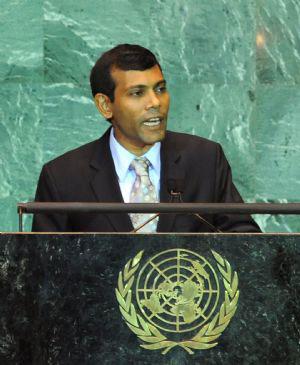
Over 40 people joined together to stage a “die-in” (photos) to remind the Ministers what is at stake in Copenhagen – human lives. As the “die-in” developed people collapsed to represent deaths attributed to extreme drought, sea level rise and floods, spreading of diseases, and extensive heat waves. As dozens of people lay dead at the entrance of the press conference excerpts from the “Suicide Pact or Survival Pact” speech given by President Nasheed of the Maldives at the Climate Vulnerable Forum was read aloud. The die-in then turned into a resurrection as the victims arose chanting President Nasheed’s cry of “We will not die quietly” (video). President Nasheed’s calls strike to the core of why a climate treaty is needed, and reinvigorates the commitment that we will not stand quietly as ambition is lowered and climate commitments are avoided.

This week world leaders again dropped the bar of ambition for Copenhagen even lower. Nations like the US and China continue to work on a mandate of delay rather than a mandate of possibility, with half measures and political gamesmanship. Delay kills, but possibility allows for greatness.

We will not go quietly. With t-minus 21 days, anything is possible.

You can follow actions at the COP meeting at www.twitter.com/copactions

Additional Photos and Videos

Article Source


Find more photos like this on The Copenhagen Voice
by Michael Wright & Green Thing


As the Copenhagen Summit is our climate's last chance saloon, it would help if we all understood what's got to happen there. To make that simple, Green Thing has produced a Quick Recipe for a Successful Copenhagen with diplomacy illustrated through the medium of cookery. Watch it. Share it. Don't try to cook it. And remember, as Chef says: "It does not have to be pretty, it just has to work."

Featuring the hands of Marc Danbury, the lighting of Richard Laing, the camera support of Stuart Bunce, the post production of Magic Films, the dulcet tones of Daniel Lapaine and the writing and directing skills of Michael Wright from an original recipe by Green Thing. Serves 202 countries.

PS. Here Are Five Copenhagen Campaigns You Can Get Involved With...
1) Join Tck Tck Tck - http://tcktcktck.org
2) Take the 350 pledge - http://bit.ly/nVcbm
3) Make the wave - http://www.the-wave.org.uk
4) Seal the deal - http://bit.ly/hOMpl
5) Help Avaaz global action - http://bit.ly/3Iv5pn

And for a round-up of the rest: http://bit.ly/162BdZ

Article Source

There are just over four weeks to go before the Copenhagen conference intended to agree a new international framework for controlling greenhouse gas (GHG) emissions. The final round of preparatory talks in Barcelona has revealed deep divisions between some of the key participants. Use this table to study their positions.

Country What's on the table Climate facts (2007) Public opinion
China
China image
"Developed countries should support developed countries in tackling climate change." President Hu Jintao, 22/9/09
  • Wants rich countries to reduce emissions to 40% below 1990 level by 2020
  • Says they should pay 1% of their GDP per year to help other countries adapt
  • Promises to emit "notably" less CO2 per unit of GDP by 2020
  • Wants West to provide low-carbon technology
  • May be ready to name a date when China's emissions will peak
  • The world's biggest GHG producer (20.7% of global emissions, 8,106mt of CO2 equivalent)
  • Emissions per head: 30th in the world (6t of CO2 equivalent)
  • GDP (2008): $4.3tn
  • Amount of GHG emitted per $1m of GDP: 1,152t
  • Kyoto: Signed as a developing country so not obliged to cut emissions
How serious a threat is global warming to you and your family?

Very/Somewhat serious
33% positive

Not very/Not at all serious
62% negative
United States
US image
"We understand the gravity of the climate threat. We are determined to act. And we will meet our responsibility to future generations." Barack Obama, US president, 22/9/09
  • Resisting demands to pledge quantified emissions cuts
  • Against Kyoto-style treaty imposing international legal obligations
  • Insists China, India, South Africa and Brazil must commit to slow growth of emissions
  • Climate bill - which would bring cuts of 4% from 1990 levels by 2020 - is bogged down in Senate
  • The world's second-biggest GHG producer (15.5% of global emissions, 6,087mt of CO2 equivalent)
  • Emissions per head: Fifth in the world (20t of CO2 equivalent)
  • GDP (2008): $14.2tn
  • Amount of GHG emitted per $1m of GDP: 441t
  • Kyoto: Signed, but never ratified
How serious a threat is global warming to you and your family?

Very/Somewhat serious
64% positive

Not very/Not at all serious
36% negative
EU
EU image
"We are going to over-achieve our Kyoto targets." Stavros Dimas, EU environment commissioner, 27/10/09

The EU is a grouping of 27 European states
  • Aspires to play "leading role" at Copenhagen
  • Will cut emissions by 20% from 1990 levels by 2020, or 30% if other big emitters take tough action
  • Wants rich nations to make 80-95% cut by 2050
  • Wants poorer nations to slow emissions growth
  • Says they face costs of $150bn per year by 2020, of which EU will pay $7bn-22bn from public finances
  • The world's third-biggest GHG producer (11.8% of global emissions, 4,641mt CO2 equivalent)
  • Emissions per head: 17th in the world (9t of CO2 equivalent)
  • GDP (2008): $18.3tn
  • Amount of GHG emitted per $1m of GDP: 315t
  • Kyoto: Signed - has to get average emissions for 2008-2012 8% below 1990 level
How serious a threat is global warming to you and your family?

Very/Somewhat serious
62% positive

Not very/Not at all serious
32% negative (Results represent the median of 23 out of the 27 EU states polled by Gallup)
India
India image
"Internationally legally binding [greenhouse gas] reduction targets are for developed countries and developed countries alone." Jairam Ramesh, India's environment minister, 21/10/09
  • Agrees to limit growth of GHG emissions but will not commit to binding targets
  • Says rich countries are to blame for climate change and points to big gap in per capita emissions
  • Wants deep cuts in rich country emissions, firm funding pledges and technology transfer
  • Keen on preserving Kyoto-style legal obligations for developing countries
  • The world's sixth-biggest GHG producer (5% of global emissions, 1,963mt of CO2 equivalent)
  • Emissions per head: 66th in the world (2t of CO2 equivalent)
  • GDP (2008): $1.2tn
  • Amount of GHG emitted per $1m of GDP: 655t
  • Kyoto: Signed as a developing country, so not obliged to cut emissions
How serious a threat is global warming to you and your family?

Very/Somewhat serious
81% serious

Not very/Not at all serious
13% not serious
Japan
Japan image
"We think developing countries are also required to make an effort to reduce greenhouse gases." Yukio Hatoyama Japan's prime minister, 7/9/09
  • Will cut emissions to 25% below 1990 levels by 2020, if other countries show similar ambition
  • This amounts to a cut of 30% in 10 years, and is opposed by industry
  • "Hatoyama initiative" will increase financial and technical assistance to developing countries
  • Backs proposals in which each country would set its own commitments
  • The world's seventh-biggest GHG producer (3.3% of global emissions, 1,293mt of CO2 equivalent)
  • Emissions per head: 15th in the world (10t of CO2 equivalent)
  • GDP (2008): $4.9tn
  • Amount of GHG emitted per $1m of GDP: 301t
  • Kyoto: Signed - has to get average emissions for 2008-2012 6% below 1990 level
How serious a threat is global warming to you and your family?

Very/Somewhat serious
75% serious

Not very/Not at all serious
25% not serious
African union
African union image
"We are prepared to walk out of any negotiations that threaten to be another rape of the continent." Meles Zenawi of Ethiopia, 3/9/09

The African Union is a grouping of 52 African states
  • Like China, wants rich countries legally bound to cut emissions to 40% below 1990 level by 2020
  • Describes 20 to 30% cuts as "unacceptable"
  • Wants rich countries to pay 0.5% of GDP to help developing countries tackle climate change
  • Wants $67bn per year for adaptation in Africa
  • Threatening to walk out if demands are not met
  • The AU accounts for 8.1% of global emissions (3,164mt of CO2 equivalent)
  • Emissions per head: 4t of CO2 equivalent
  • GDP (2008): $34bn
  • Amount of GHG emitted per $1m of GDP: 1,361t
  • Kyoto: African nations signed as developing countries so are not obliged to cut emissions
How serious a threat is global warming to you and your family?

Sample state, Kenya:

Very/Somewhat serious
87% serious

Not very/Not at all serious
12% not serious
Gulf states
Gulf states image
"We are among the most economically vulnerable countries." Mohammad S. Al Sabban, Saudi Arabia's lead negotiator 8/10/09

Bahrain, Kuwait, Oman, Qatar, Saudi Arabia, UAE
  • Opec and Saudi Arabia seeking financial aid for oil-producers if new agreement requires cuts of fossil fuels
  • Keen on a deal that would advance use of carbon capture and storage
  • In 2007 Opec members pledged $750m to fund climate change research
  • Qatar and Abu Dhabi investing heavily in clean energy technology
  • Gulf states account for 2.3% of global emissions (894mt of CO2 equivalent)
  • Emissions per head: 25t of CO2 equivalent
  • GDP (2008): $468bn
  • Amount of GHG emitted per $1m of GDP: 875t
  • Kyoto: Gulf States signed as developing countries so are not obliged to cut emissions
How serious a threat is global warming to you and your family?

Sample state, Saudi Arabia:

Very/Somewhat serious
82% serious

Not very/Not at all serious
16% not serious
Small islands
Small islands image
"The days of little money in the face of big problems are over." Dessima Williams, head of the Alliance of Small Island States (Aosis), 9/10/09

Aosis is a bloc of 42 island and coastal states mostly in the Pacific and Caribbean
  • Regard rising sea level as threat to their existence
  • Seek to limit temperature rise to 1.5 degrees above preindustrial levels
  • Want concentration of CO2 in atmosphere lowered from 380 to 350 parts per million
  • Want global emissions to peak by 2015 and fall 85% below 1990 level by 2050
  • Want at least 1% of rich country GDP spent on "climate-inflicted damage"
  • The small island states account for 0.6% of global GHG emissions (246mt of CO2 equivalent)
  • Emissions per head: 4t of CO2 equivalent
  • GDP (2008): $46bn
  • Amount of GHG emitted per $1m of GDP: 551t
  • Kyoto: Aosis members signed as developing countries so are not obliged to cut emissions
How serious a threat is global warming to you and your family?

Sample state, Dominican Republic:

Very/Somewhat serious
91% serious

Not very/Not at all serious
8% not serious

SOURCES: Potsdam Institute for Climate Impact Research and the World Bank. Gallup poll data taken in 2008. Between 528 and 2,493 people interviewed in each country, either by phone or face-to-face (the question was put to people who said they knew something about climate change). The margin of error ranges from +/-3.5 to +/-5.3%.

Article Source


Your Excellencies, distinguished guests, ladies and gentlemen,

We gather in this hall today, as some of the most climate-vulnerable nations on Earth.

We are vulnerable because climate change threatens to hit us first; and hit us hardest.

And we are vulnerable because we have modest means with which to protect ourselves from the coming disaster.

We are a diverse group of countries.

But we share one common enemy.

For us, climate change is no distant or abstract threat; but a clear and present danger to our survival.

Climate change is melting the glaciers in Nepal.

It is causing flooding in Bangladesh.

It threatens to submerge the Maldives and Kiribati.

And in recent weeks, it has furthered drought in Tanzania, and typhoons in the Philippines.
We are the frontline states in the climate change battle.

Ladies and gentlemen,

Developing nations did not cause the climate crisis.

We are not responsible for the hundreds of years of carbon emissions, which are cooking the planet.

But the dangers climate change poses to our countries, means that this crisis can no longer be considered somebody else’s problem.

Carbon knows no boundaries.

Whether we like it or not, we are all in this fight together.

For all of us gathered here today, inaction is not an option.

So, what can we do about it?

To my mind, whatever course of action we take must be based on the latest advice of climate scientists. Not on the advice of politicians like us.

As Copenhagen looms, and negotiators frantically search for a solution, it is easy to think that climate change is like any other international issue.

It is easy to assume that it can be solved by a messy political compromise between powerful states.

But the fact of the matter is, we cannot negotiate with the laws of physics.

We cannot cut a deal with Mother Nature.

We have to learn to live within the fixed planetary boundaries that nature has set.

And it is increasingly clear that we are living way beyond those planetary means.

Scientists say that global carbon dioxide levels must be brought back down below 350 parts per million.

And we can see why.

We have already overshot the safe landing space.

In consequence the ice caps are melting.

The rainforests are threatened.

And the world’s coral reefs are in imminent danger.

Members of the G8 rich countries have pledged to halt temperature rises to two degrees Celsius.

Yet they have refused to commit to the carbon targets, which would deliver even this modest goal.

At two degrees we would lose the coral reefs.

At two degrees we would melt Greenland.

At two degrees my country would not survive.

As a president I cannot accept this.

As a person I cannot accept this.

I refuse to believe that it is too late, and that we cannot do any about it.

Copenhagen is our date with destiny.

Let us go there with a better plan.

Ladies and gentlemen,

When we look around the world today, there are few countries showing moral leadership on climate change.

There are plenty of politicians willing to point the finger of blame.

But there are few prepared to help solve a crisis that, left unchecked, will consume us all.
Few countries are willing to discuss the scale of emissions reductions required to save the planet.

And the offers of adaptation support for the most vulnerable nations are lamentable.

The sums of money on offer are so low, it is like arriving at a earthquake zone with a dustpan and brush.

We don’t want to appear ungrateful but the sums hardly address the scale of the challenge.

We are gathered here because we are the most vulnerable group of nations to climate change.

The problem is already on us, yet we have precious little with which to fight.

Some might prefer us to suffer in silence but today we have decided to speak.

And so I make this pledge today: we will not die quietly.

Ladies and gentlemen,

I believe in humanity.

I believe in human ingenuity.

I believe that with the right frame of mind, we can solve this crisis.

In the Maldives, we want to focus less on our plight; and more on our potential.

We want to do what is best for the planet.

And what is best for our economic self-interest.

This is why, earlier this year, we announced plans to become carbon neutral in ten years.
We will switch from oil to 100% renewable energy.

And we will offset aviation pollution, until a way can be found to decarbonise air transport too.

To my mind, countries that have the foresight to green their economies today, will be the winners of tomorrow.

They will be the winners of this century.

These pioneering countries will free themselves from the unpredictable price of foreign oil.
They will capitalize on the new, green economy of the future.

And they will enhance their moral standing, giving them greater political influence on the world stage.

Here in the Maldives we have relinquished our claim to high-carbon growth.

After all, it is not carbon we want, but development.

It is not coal we want, but electricity.

It is not oil we want, but transport.

Low-carbon technologies now exist, to deliver all the goods and services we need.
Let us make the goal of using them.

Ladies and gentlemen,

A group of vulnerable, developing countries committed to carbon neutral development would send a loud message to the outside world.

If vulnerable, developing countries make a commitment to carbon neutrality, those opposed to change have nowhere left to hide.

If those with the least start doing the most, what excuse can the rich have for continuing inaction?

We know this is not an easy step to take, and that there might be dangers along the way.

We want to shine a light, not loudly demand that others go first into the dark.

So today, we want to share with you our carbon neutral strategy.

And we want to ask you to consider carbon neutrality yourselves.

I think a bloc of carbon-neutral, developing nations could change the outcome of Copenhagen.

At the moment every country arrives at the negotiations seeking to keep their own emissions as high as possible.

They never make commitments, unless someone else does first.

This is the logic of the madhouse, a recipe for collective suicide.

We don’t want a global suicide pact.

And we will not sign a global suicide pact, in Copenhagen or anywhere.

So today, I invite some of the most vulnerable nations in the world, to join a global survival pact instead.

We are all in this as one.

We stand or fall together.

I hope you will join me in deciding to stand.

Speech Source
More about President Mohamed Nasheed
2009/11/08 -K.C. BOEY

CLIMATE change is getting everyone hot under the collar in the remaining month to Copenhagen. The politicians are raising their hype, playing to their respective lobbies, but the scientists and environmentalists are in no doubt: we are close to irreversible damage.

Nonsense, the bean counters sniff. The people who hold the purse strings, the sceptics and the plain selfish just want to go on spending lavishly, consuming voraciously, polluting like there was no tomorrow.

The science is in. But how does one get the message across, with all the politics and convoluted sums and arguments, at events such as the United Nations Climate Change Conference in Copenhagen from Dec 7-18?

Climate change barely rated a mention at the environmental awards presentation at the local council the other night. Sustainability was grandma's common sense.

The environment had meaning. From the traditional owners of the land, to schools and the local church, sustainability is second nature, it would appear.

Sustainable living is not "news", mayor David Cooper would tell those gathered in his council of Knox, in Victoria, to receive the Knox Environment Awards.

Indigenous Australians, traditional owners of the land descended from the longest-surviving culture in the world, have known this going back 40,000 years.

There was no question of choice for them then; it was a matter of survival.

"Modern" Australia for a while lost its way. Now it is discovering the folly of its recent past.

Scientists in their high towers and global and national leaders can debate climate change. On the ground, many are thinking global, acting local.

Councils such as Cooper's are switching light bulbs to energy-saving types, taking ratepayers to the supermarkets to show them how to "buy green", and thinking green in purchase of vehicles.

Knox is one of many councils that support a partnership by state government and business to give and install light bulbs in households for free. In return, households assign carbon credits to the commercial enterprise.

Initiatives such as these may not save the council big bucks, but as Andrew Paxton, Knox manager on sustainability, said at the awards night, the value is in the council "leading by example".

Knox's environment awards have been going for 15 years, in which community organisations, schools, business and individuals are recognised for their achievements on environmental sustainability.

One winner, a church, had no idea there was money in it when it went to its architect five years ago, with the brief to redevelop its building with a small environmental footprint.


It was nominated for the awards to lead by example. The A$1,000 (RM3,000) that came with the award was a surprise bonus.

For members of the church, and others at the Knox awards night, Copenhagen would need no persuasion. Ideas about environmental sustainability flow from the ground up to argument about climate change at the top.

Energy, Green Technology and Water Minister Datuk Peter Chin Fah Kui is in good company. Charged with laying the groundwork for Malaysia to head off "two of the world's most pressing issues", he had planned to start "from the ground up".

As with Knox council and others at the local level, grassroots action don't look anything like game-changers.

Chin had had no idea about what local councils in Australia were doing, but the thought had struck him of a campaign to switch households to energy-saving light bulbs.

That was to plant the seeds of the green technology idea that Datuk Seri Najib Razak escalated to policy when he became prime minister in April, creating the ministry that Chin heads.

Green technology is no nostalgic fad to preserve Planet Earth. As Najib put it at the policy launch in July, green technology can drive innovative economic growth.

It can "deliver the double impact" of accelerating economic growth while reducing Malaysia's carbon footprint, at the same time creating "green collar" jobs.

Najib pressed for green technology and carbon capture and storage (CCS) when Australian Prime Minister Kevin Rudd dropped by Kuala Lumpur early in July, on his way to Italy for the G8+ meeting.

Almost all -- 92 per cent -- of Peninsular Malaysia's energy needs come from fossil fuels: 59 per cent from gas and 33 per cent coal, with eight per cent from hydro.

Now Malaysia is building a coal-fired station in Sabah.

"The reduction of CO2 emission is a matter of concern to us," Loo Took Gee, ministry deputy secretary-general (energy), tells the New Sunday Times. "That is why we are moving into renewable energy and energy efficiency, in order to reduce greenhouse gas emissions."

Coal is the biggest contributor to greenhouse gas emissions. Australia has an interest to keep a lid on it. Coal is the country's biggest export earner.

Rudd had fast-tracked the Global Carbon Capture and Storage Institute (GCCSI) in Canberra, which he launched in April. The institute started work the week Rudd stopped over in Kuala Lumpur.

The two prime ministers agreed that a ministerial visit from Malaysia to Australia could be useful. Which led to Chin heading a nine-person delegation, among them Loo, to Australia.

The delegation called on counterpart ministers, and visited far-flung research centres and marketing operations.

Among the visits were to the Commonwealth Scientific and Industrial Research Organisation, (and wiki here) energy market commission and operator, Cooperative Research Centre for Greenhouse Gas Technologies (CO2CRC), GCCSI and Green Building Council of Australia.

Chin was expansive on his ministry's plans during a three-hour drive from Melbourne to Otway to visit Australia's first demonstration of carbon geosequestration, or the storage of carbon dioxide deep underground.

Malaysia had much to learn, while looking ahead to the global exhibition of green technologies in Kuala Lumpur next year, Chin tells the New Sunday Times.

At the same time, the seeds of sustainable living have to be planted in the people, through education campaigns and in initiatives such as changing the light bulbs.

Article Source